




The former India fast bowler talks about overthinking, being coached by Dennis Lillee, breaking Stuart Broad's nose, and coping with injury
Varun Aaron is addicted to all things fast. His career in fast bowling may be over, but he still has targets for how quick he needs to run, and plans to defy his parents' instructions and buy himself a motorbike. In this interview, he talks about his journey from Jharkhand to the Indian team, and how injuries ultimately led him to understanding the craft, and his own body, better.
When we talk about the superstars of Indian cricket, by and large they are batters. But what I've noticed about Indian cricket fans is that if there's something that excites them beyond batting, it's fast bowling. Fast bowlers stay in our heart. Do you feel that as a fast bowler when you interact with people?
Absolutely. I think fast bowlers have more of a cult following. I would equate it to somebody like Quentin Tarantino. It's a very different audience altogether. Men and women who like fast bowling just love it. They love it just for the pure art and for what a fast bowler can bring to the context of a game - absolute destruction.
It's the sexy thing about cricket, isn't it?
I mean, anything fast is sexy.
Was that the appeal when you were first drawn to cricket?
I was always obsessed with speed because I wanted to be a fighter pilot. The first image I drew was of a fighter plane. The first comic I read was a Commando [war] comic. I just love those fighter jets, those Spitfires, those Mustangs. So it was always speed in my head. Every Sunday, My dad and I would watch Calypso Classics [TV show on West Indies cricket]. He loves fast bowling and he would talk about Andy Roberts and Michael Holding and Joel Garner. And I would see them bowling, hitting guys on the head, shattering stumps. So I grew up with that data being fed into my brain.
Finally, I chose the easy road, which is batting, obviously. And when I was 12, the deal between me and my mom was that if I'm not among the top ten in my class, I will not be allowed to go for cricket practice. I came 15th or 16th and Mom was like: you cannot go for cricket practice for a whole term. So I ended up going after three months.
The coach was very, very angry. He said, "You're not going to bat, you're only going to bowl." I was obviously angry and I started bowling really fast. I might have gone through a growth spurt then as well. Then all the guys in the camp were like, why are you playing the state Under-14 trials as a batsman? Why don't you try as a fast bowler? And the rest is history.
'You've got to eat, breathe, sleep, drink fast bowling'
So before that, you largely batted?
I mostly batted because I was my dad's stress-buster after work. He would bowl to me and he would hit my head, hit me on the ribs, or my legs.
With a cricket ball?
No, no, with a tennis ball. My dad wasn't torturing me! But I actually enjoyed batting against fast bowlers.
So at 12, you were told, you've not shown up for training for three months, so you're going to bowl and…
I just took a random run-up. I wanted to break every batsman's head in the nets that day. It was [because of] sheer anger that I ended up bowling that fast. And then I gave my first state trial as a fast bowler. I was selected for the state team, but I think I had my first stress fracture then. The next year, once I healed, I started playing for my state.
Were you right away faster than all the other boys in that group?
I was. I went to Loughborough University when I was 16 to do a full biomechanical assessment on my action and they measured my speed there. They measured it indoors and I wasn't wearing spikes, so I wasn't off my full run. I measured 137kph when I was 16. So yeah, I was always quicker than the rest.
How did it make you feel when coaches started saying you can bowl fast?
From the age of 14, I worked very closely with Dennis Lillee. And he is the ultimate disciplinarian. If you're 14 and you meet Dennis Lillee and you imbibe what he teaches as a fast-bowling coach, not just technique-wise but also mentally, I think that holds you in good stead for life.
What for you was the most memorable aspect of that philosophy?
The first thing he said in one of those group talks was that fast bowling is a lifestyle. And I truly believe fast bowling is a lifestyle. You've got to eat, breathe, sleep, drink fast bowling. There's no days off. I actually took my first holiday around 2020. After 17 years of cricket, that was my first holiday. I'd never taken a holiday. I'd gone for two-three-day getaways, but I'm talking about a two-week holiday. I was always obsessing over my body being in pristine shape, being able to bowl as fast as possible. I felt I had a gift to bowl fast and I wanted to make sure I fulfilled that gift.
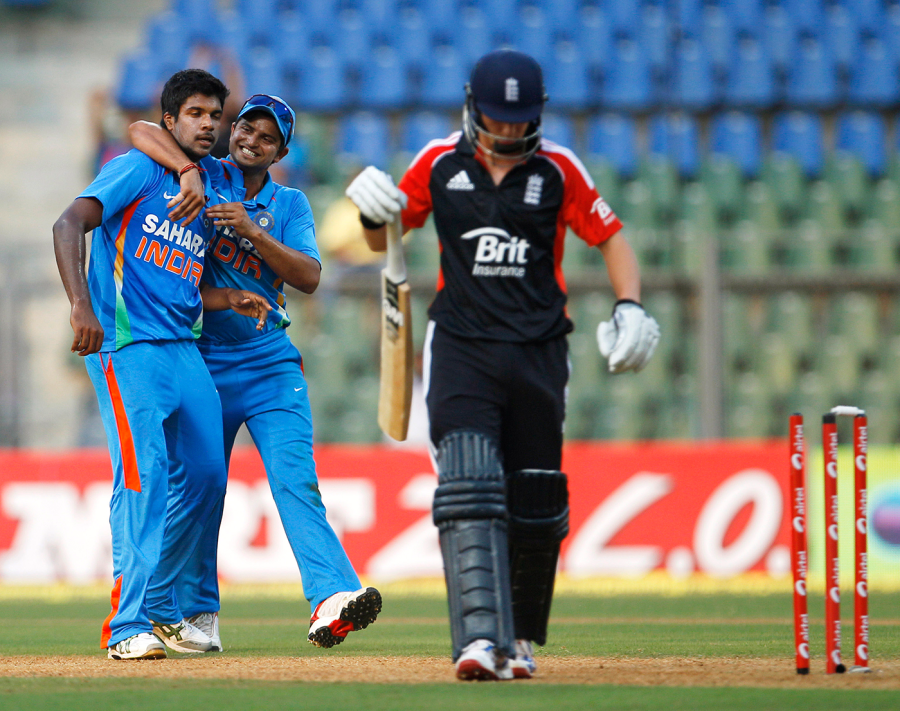
Aaron made his India debut in 2011 and took 3 for 24 against England in his first ODI
Aijaz Rahi / © Associated Press
I'm sure it was not an easy lifestyle to choose for a teenager. You didn't know it was going to lead to state selection. Did the choice to live that hard life come easily?
Yeah, it did, because it was about the higher purpose, the mission, which was to play for India. I wasn't really focusing on playing for India until 2000. There was a season of U-19 cricket in my last year of school, which was when I really believed that I would play for India and that nothing is going to stop me. And in the next two years I played for the country.
Since your mom was a disciplinarian, once the cricket started picking up, did it affect her mood or support for you?
My mom's family is very athletic. My grandad played hockey for Bihar. Mom represented Bihar and Karnataka in basketball. So they understood sport. The moment I started doing well in age-group cricket, they really believed that this guy can actually do something decent.
Before meeting Dennis Lillee, I was a lazy guy. My dad would kick me out at five o'clock in the morning for a run. "You can't be sleeping, do something physical." And I would cycle around everywhere in Jamshedpur. I would go to school cycling, then I would go for tuition and for cricket practice. All that cycling, with my kit and my school bag, gave me a lot of strength in my legs.
There is this image of fast bowlers terrorising batters in the pre-helmet days. Did it excite you?
Yeah, it did excite me. I always loved a sense of danger. I feel life is incomplete without a sense of danger. There has to be an adrenaline rush at some point in my life… it just gives me a kick.
What adventurous things you have done off field so far?
I have done skydiving. I'm thinking of starting free-diving now, because as a fast bowler, it's such a thrill to send the ball down at a high speed and see it thud into the keeper's gloves or break a few stumps or a bail. When suddenly that's removed from your life [when you retire], you want another outlet which is constructive, not destructive. So yeah, I'm just looking at different avenues to make sure that side of me is satiated.
'Remodeling my action made me understand fast bowling to another level'
I enjoy running. I feel running gives me a lot of peace. It puts me in a zone which I like to be in and it obviously keeps me fit. The day I can't run 5km at a certain pace, I'll just be really upset with myself, because that's my measure of physical fitness. You have to be able to run a minimum of 5k under 25 minutes - this is a worst-case scenario I'm talking about, when I'm 35 and not playing. When I was in my peak fitness, I was running it in about 19 minutes.
Bowling is one of the most unnatural things our body is asked to do in sport. You are asking your body to challenge itself in terms of where the pressure is on muscles versus where the weight is versus what you then need to generate with your back and arm…
Your spine is designed to either bend forward, bend back or bend to the side. But in fast bowling, all three happen in one single action. So you extend, you laterally flex, and you bend forward in one movement. Bowling with a straight arm, you're not chucking it. I mean, as humans, we are meant to chuck things, stones and stuff like that. Nowhere in the Stone Age were guys running around trying to hit a mango like this [with a straight arm]. So it is very, very unnatural.
When you were around 14, you already had exposure to Dennis Lillee's coaching at the MRF Pace Foundation in Chennai. At what point did the cricket start getting serious for you?
So to get in and to get coached by Lillee at 14 was quite a big deal in Jharkhand. Generally, people who would get selected for that programme would be 19 or 20. When I went for trials, there were guys like Manpreet Gony [former India fast bowler who is more than five years older than Aaron] towering above me at 6ft 3in. I was like: why am I even here? But I think Lillee and TA Sekar [former India fast bowler] saw something in me and picked me for that fast-bowling programme. That, more than anything else, mentally conditioned me to take the rigours of fast bowling.
Did you have a reputation of being fast in your age group? Were batters a little worried that you'd hit them?
I'll be really honest. I didn't have a clue of what was going on around me. All I wanted to do was eat good food, bowl fast, train and go to sleep. I mean, even now, that's pretty much what my life is about. I was quite naive. I actually started to be a little aware of my surroundings [only] when I was 25-26. I was looking back at my journey one day and I realised that, yes, I like cricket, but what I actually love is just bowling fast.
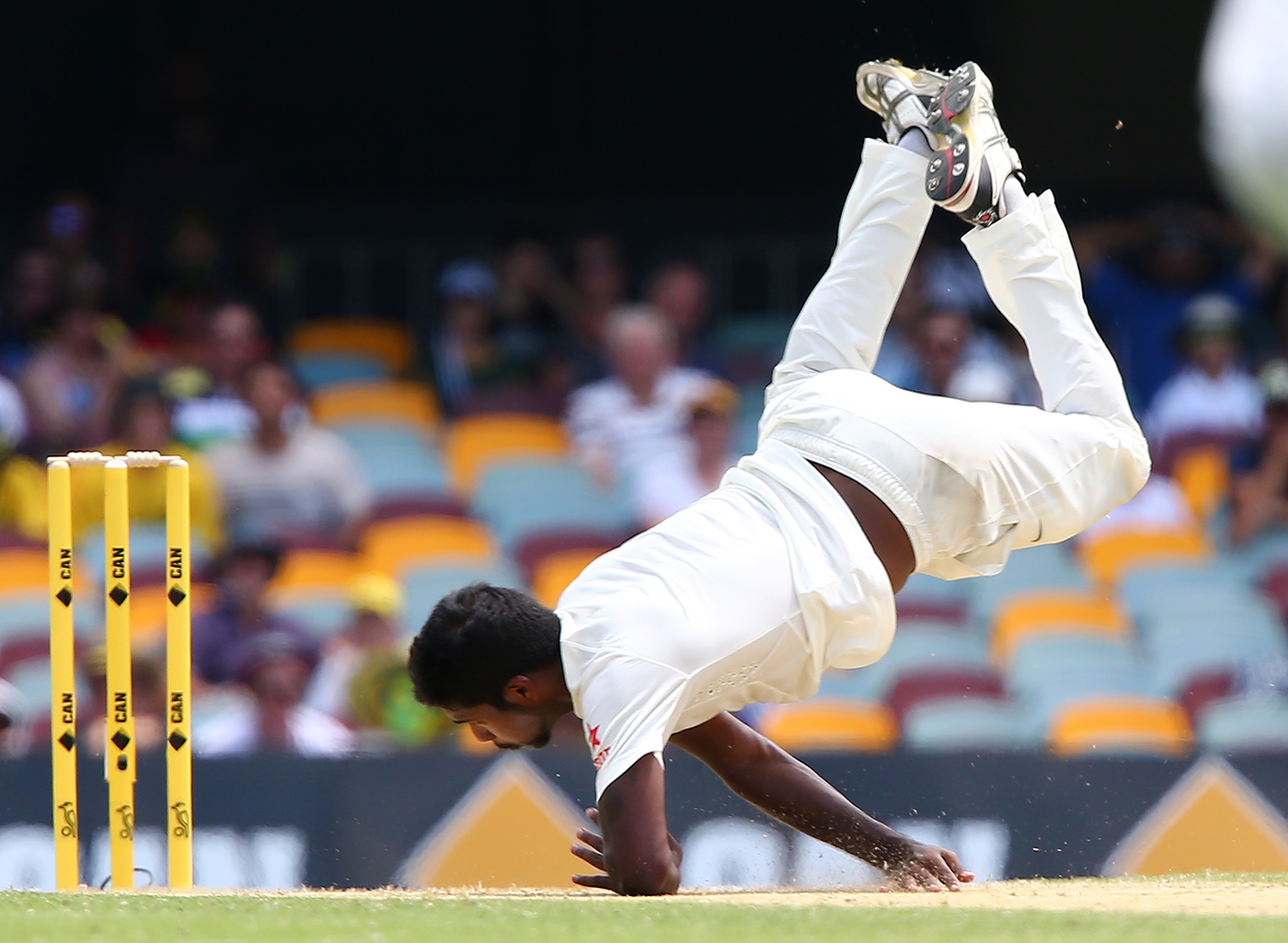
On his long battle with injury: "When I was 14, before any coach could touch me, I used to bowl with a semi-open back foot. But through coaching, my action got changed [...] which was not great at all"
© Getty Images
You were 19 when you made your debut for Jharkhand. I believe you clocked 153kph a couple of seasons later. And the national call-up came on the back of that?
Jharkhand won the first and only trophy we've ever won, in the 2010-11 Vijay Hazare Trophy [50 overs]. We still remember the final against Gujarat very fondly. After that I played a Deodhar Trophy game and got five wickets against West Zone.
Then they picked me for India Emerging Players in Australia. I got [six] wickets in a game. Then they picked me [in the white-ball squads] for India's 2011 tour of England. I didn't play in the series, but when I came back home, that's when I debuted [in ODIs and Tests].
This was a time when Jharkhand had been put on the cricket map courtesy MS Dhoni. How did it make you feel? Because otherwise Indian captains or superstars did not hail from the state.
True. I think there was a lot of belief in the state that we can actually play for the country. Because in our memories, we didn't have somebody to look at who had played for the country. People like Subroto Banerjee and Ramesh Saxena, who are much, much older to us, had played for the country, but we had never seen somebody play for the country. And Dhoni was the Indian team captain who had just won the World Cup.
The other thing is, that was actually the golden period of Jharkhand's cricketing history, because in that one batch of the U-19s that I was a part of, about five or six of us played in the IPL and three of us played for India. It was a great batch, backed by a lot of good administration. What Rajesh Verma [former secretary of the Jharkhand Cricket Association] did for our state, with our leagues and camps, was second to none.
You love fighter jets. What else fascinated you growing up?
I love anything fast. I love fast cars, fast bikes. I hate to walk. I'd rather run than walk. Or if I walk, I walk really fast. My dad never let me buy a bike because he was like, you're getting injured on the field enough, you don't need a bike to get injured again. But I'm going to buy a bike now. I'm just [overlooking] all my mom's and dad's instructions.
'Scaring a batsman and trying to get him out of after that was part of my job'
How significant was the Emerging Players Tournament in Australia in 2011? You were playing against David Warner, Usman Khawaja. You also clocked 150kph-plus again.
Funnily, I actually played for Australia at the Emerging Players Tournament in 2008. So Warner, Khawaja, Moises Henriques, Steve O'Keefe were all my team-mates then, because the academy in Chennai had a tie-up with Cricket Australia. Me and Shrikant Wagh [Vidarbha batter] were [the overseas players] in the squad. We had our own apartment. I used to cook for him and the coach who came with us.
Being an Indian team-mate of the Aussies was so much fun. To be exposed to a different way of playing cricket from what we were playing back in India. Just how much attention to detail was given to something like a warm-up was really refreshing. I really had the good fortune throughout my career to be exposed to different cultures, playing for Durham, for Leicestershire. I think the more you're exposed to different cultures, you just start appreciating how everybody else plays cricket.
Your international call-up, in England in 2011. Were you expecting it? What were the emotions like?
I was really blasé about what was happening around me. I was just playing the game and nothing else. I remember my family had just moved from Jamshedpur to Pune. Mr Kasi Viswanathan [then a BCCI official] called me. I didn't even know who he was. I was that naive. He was like, you've been picked to represent India for the England one-day series. I still remember my dad, mom and my sister around me. They were so happy. They were all crying. And it was a big deal because I would have never imagined I would play for the country.
I believe you were replacing an injured Ishant Sharma in the side?
I don't know. I genuinely don't know. It is only when I had to make a comeback to the Indian team in 2014 - after having two years outside the game because of my back - that I started to be more aware of my surroundings.
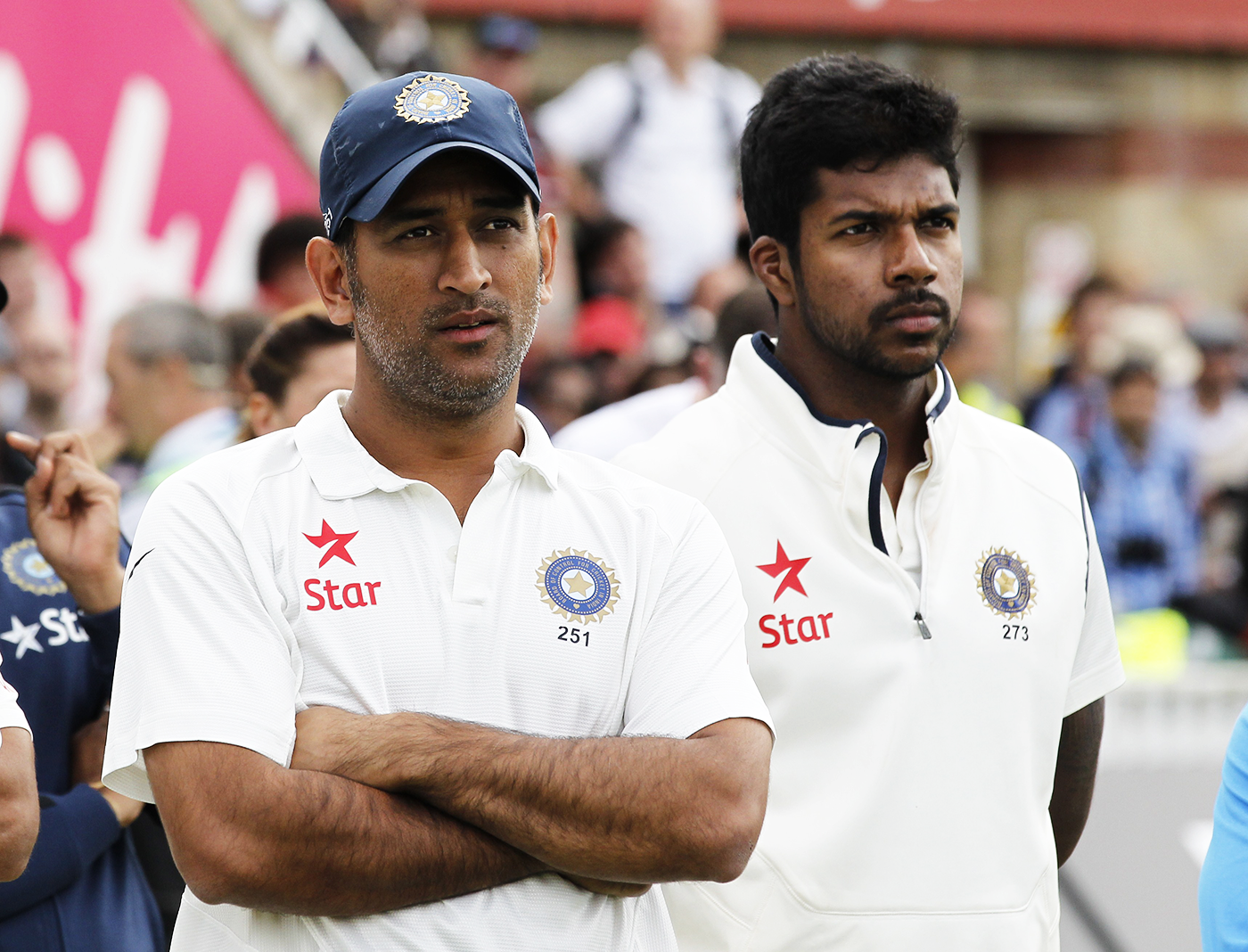
State mates: MS Dhoni and Aaron are both from Jharkhand, but their domestic careers didn't quite overlap, and they only first met when Aaron debuted for India under Dhoni's captaincy
Ian Kington / © AFP/Getty Images
Do you remember any emotions you felt from being part of a pretty star-studded Indian team and not really getting game time? Did you have interactions with anyone?
Virat [Kohli] and me hit it off and had a good relationship right from the beginning. But in the one-day team there were also a lot of faces of those I had played against in domestic cricket. And there were a lot of young players in the squad.
When I came back to India, I was part of the India-West Indies Test series. When I walked into that bus, that's when it really hit home that, dude, I'm playing for India. Because I walked in and Sachin Tendulkar was right there. Then Virender Sehwag, VVS Laxman, Rahul Dravid, Gautam Gambhir. These are guys who I've been seeing since I was growing up, you know. And I was like, man, I finally made it.
Your Test debut was quite a memorable game, where the Test was drawn with the scores level.
So it was [R] Ashwin and me [batting in the end]. We had to score two runs to win off the last ball and Ash hit it down the ground and we just ran one [Ashwin was the ninth wicket, run-out trying to take the winning run]. I remember Sachin was going to get his 100th [international] hundred, but he got caught [ for 94].
Do you remember how the last 15-20 minutes of that Test played out?
Absolutely. Duncan Fletcher [then India's coach] had not given me a single minute of batting in the nets for almost a month. Then [in the second innings], I face Fidel Edwards slinging in a reverse-swinging ball at 150 clicks. And I'm like: "Oh my god, how am I going to save this match for India?" I hit a good drive. I think Marlon Samuels was at extra cover. He fielded it. I think I might have scored a run there. But yeah, it was so much fun just batting in the middle of my debut.
What was Ashwin like at the other end?
Ash was cool, actually. He was like, just make sure you play straight, because they are going to try and hit your pads. And that's what I was thinking as well. I just did that and we ended up not losing that Test. But at the end, I told Ash, "Dude, you gotta run." I knew [Edwards] was going to bowl straight to Ash. So [I said]: "You hit it down the ground, I'm going to run too." But Ash took the safe option, which was the most sensible option - to not get run-out and just take that one run.
He did end up getting run-out.
Oh he did? That's my memory!
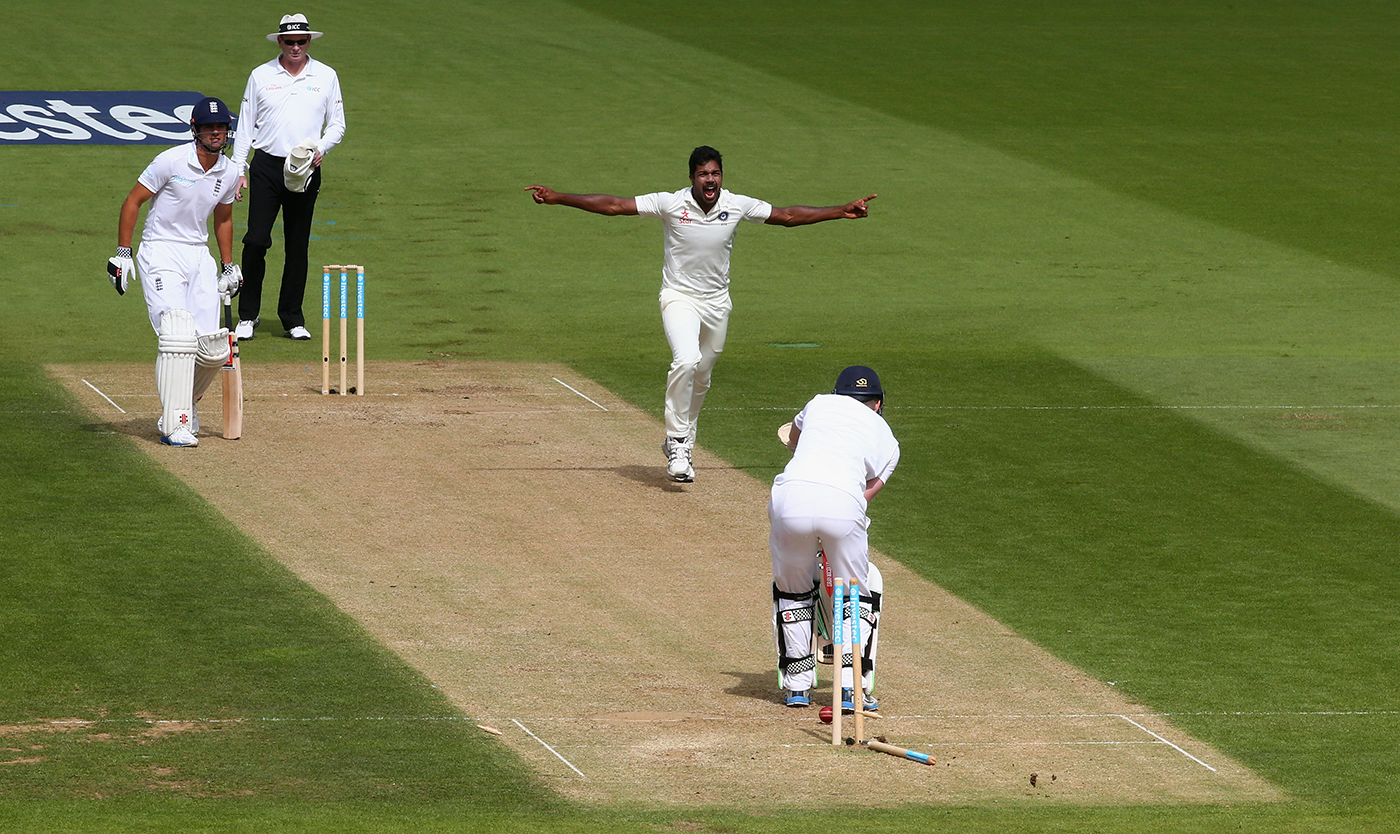
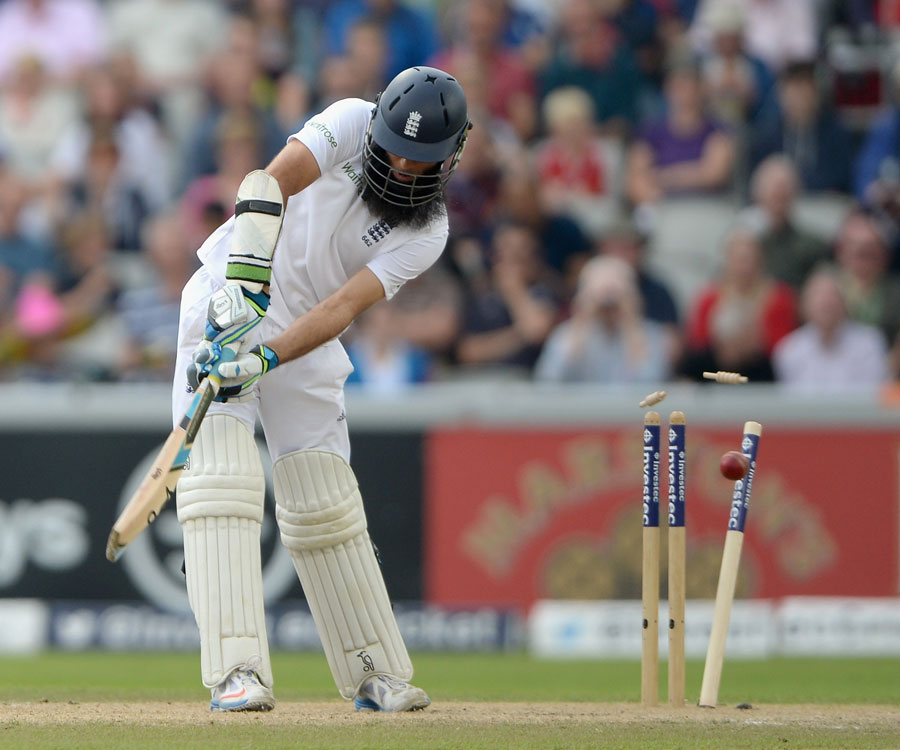
Mo' power to Aaron: Moeen Ali is bowled by a full and fast inswinging delivery at Old Trafford, 2014
© Getty Images
Then India went on the 2011-12 tour of Australia, which you missed due to injury. That must have been devastating?
It was really devastating, because I had a really good one-day debut. I got three wickets against England in great fashion. And then in one spell, I got those three wickets in my debut Test. I was just feeling so good about myself.
As a fast bowler, you want to be in a space where you turn up to a game and you just know what your body is going to give you. That was obviously cut short because I fractured my back. That was actually my fourth stress fracture and it turned out to be the most tricky stress fracture of all. I ended up having eight, but that fourth one was really, really tricky.
Can you tell us what a stress fracture does to a bowler?
A stress fracture is not like a conventional fracture. Say, you break your hand. There's swelling, there's a big crack, and you have to put in a rod and a plate. But a stress fracture is basically continuous stress on just one part of the bone, and finally you have a very, very small crack i that bone.
When you have a stress fracture in your back, you can have a lot of neural symptoms, like numbness down your leg. Then you can't extend yourself. There's a lot of pain. The moment you do anything which is stressful, you just feel like a sharp, shooting pain. You obviously can't bowl fast when you're in that shape. And yeah, I was unfortunate to have stress fractures quite a lot.
How does that affect you mentally? Did you feel at any point that maybe I won't play again?
No, I always had the belief. Even the two and a half years when I was not playing, the only thing which kept me going was the belief that I will play for India again. Not for one minute I doubted that I would make a comeback. I would go to bed every day thinking of the day I play for India. That was the kind of conviction I had.
And I moved from Jamshedpur to Bangalore because I was at the NCA [National Cricket Academy] for most of the year because of the rehab schedule. But I never doubted myself. I always knew I'd play for India, and I always knew that I'll bowl fast and I'll still bowl at 150 clicks.
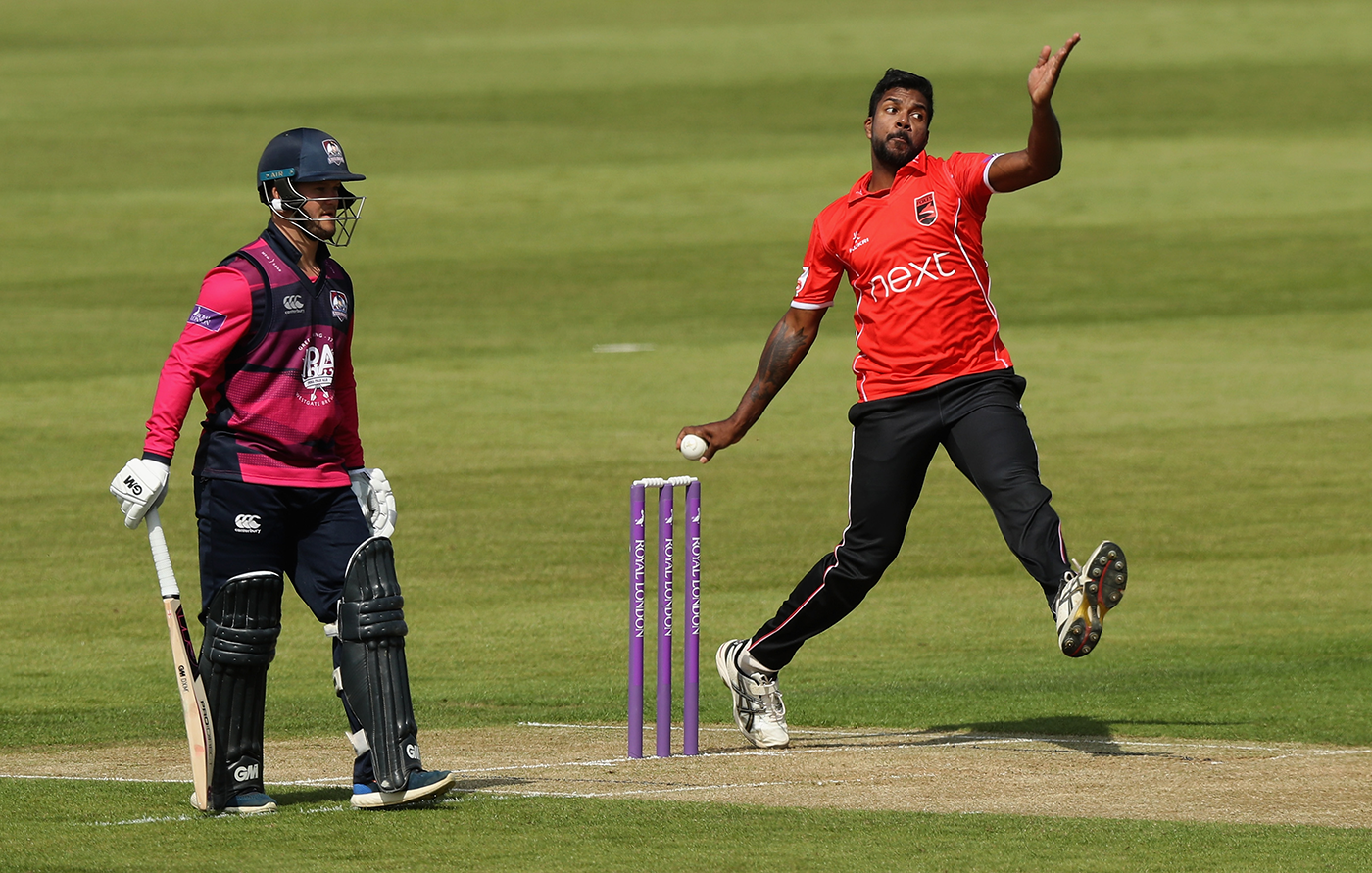
"I really had the good fortune throughout my career to be exposed to different cultures, playing for Durham, for Leicestershire. You just start appreciating how everybody else plays cricket"
David Rogers / © Getty Images
Did you at any point start feeling like: maybe it's better to start bowling differently, maybe I don't need to bowl fast?
No chance. Man, I live to bowl fast. I would have never cut down on my pace. You would be a loser if you did that.
Do you remember your first international wicket?
Yeah, it was Scotty Borthwick [in the fourth ODI vs England in Mumbai in 2011]. I got him bowled, had a nice reverse-swinging ball. I was bowling from the media end [Tata End] of the Wankhede Stadium.
You made your comeback from injury in 2014. It must have made you feel like a new man?
I actually worked really hard with Subroto Banerjee in that period on my action. Before I started working with him, I knew I had to make a change to my action to play cricket again. But to be honest, nobody in cricket, the fast-bowling coaches in India or the world, had a solution to what I needed. They weren't able to give me a solution to change my action.
You remember Roger Binny? His back leg used to face mid-on when he used to bowl. I had a past-front-on back-foot landing. Basically, my back foot would point towards first slip. And that is very, very detrimental to your balance as a fast bowler, because you can't even stand with your back leg inward. It was because of that that I was getting my stress fractures.
Nobody could give me a solution to how to correct that. I actually helped myself. One afternoon I was so frustrated, I went to the NCA indoors, got a friend of mine to just take a video of every ball. And all I told myself was to just do what comes naturally. Because when I was 14, before any coach could touch me, I used to bowl with a semi-open back foot. But obviously, through coaching, my action got changed and I got into this habit [of bowling with a closed back foot] which is not great at all. So I just let my body flow and do what it knew inherently. And suddenly I started to feel really comfortable. I asked my friend: can you show me the last video? And magically, my back foot had become semi-open. That's because I subconsciously delayed my load, like made my load a little longer. It gave me time to open up my back foot and that enabled me to come back and play for India.
I fine-tuned it with Subroto Banerjee, an unbelievable coach. He just makes everything so easy. With him, it was more fine-tuning my skill. The action bit I sorted out myself.
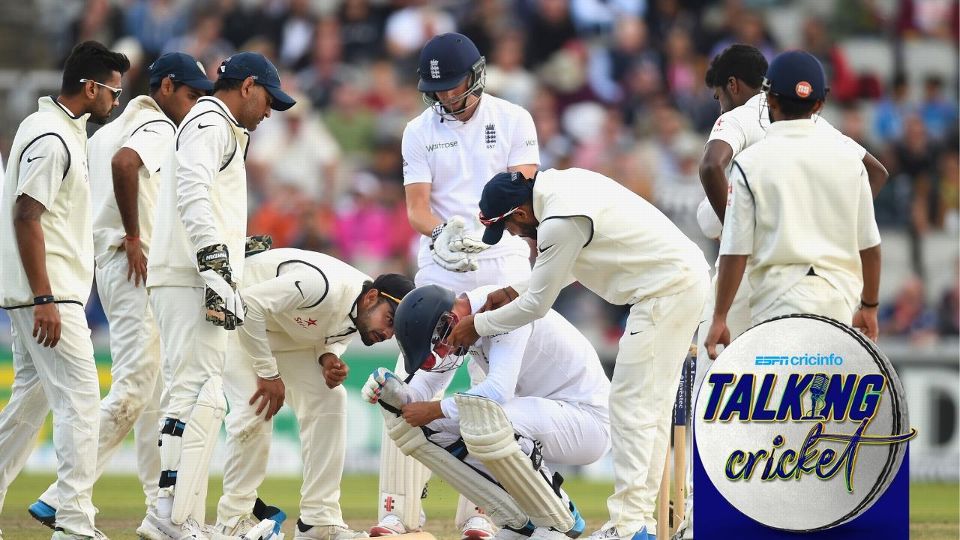
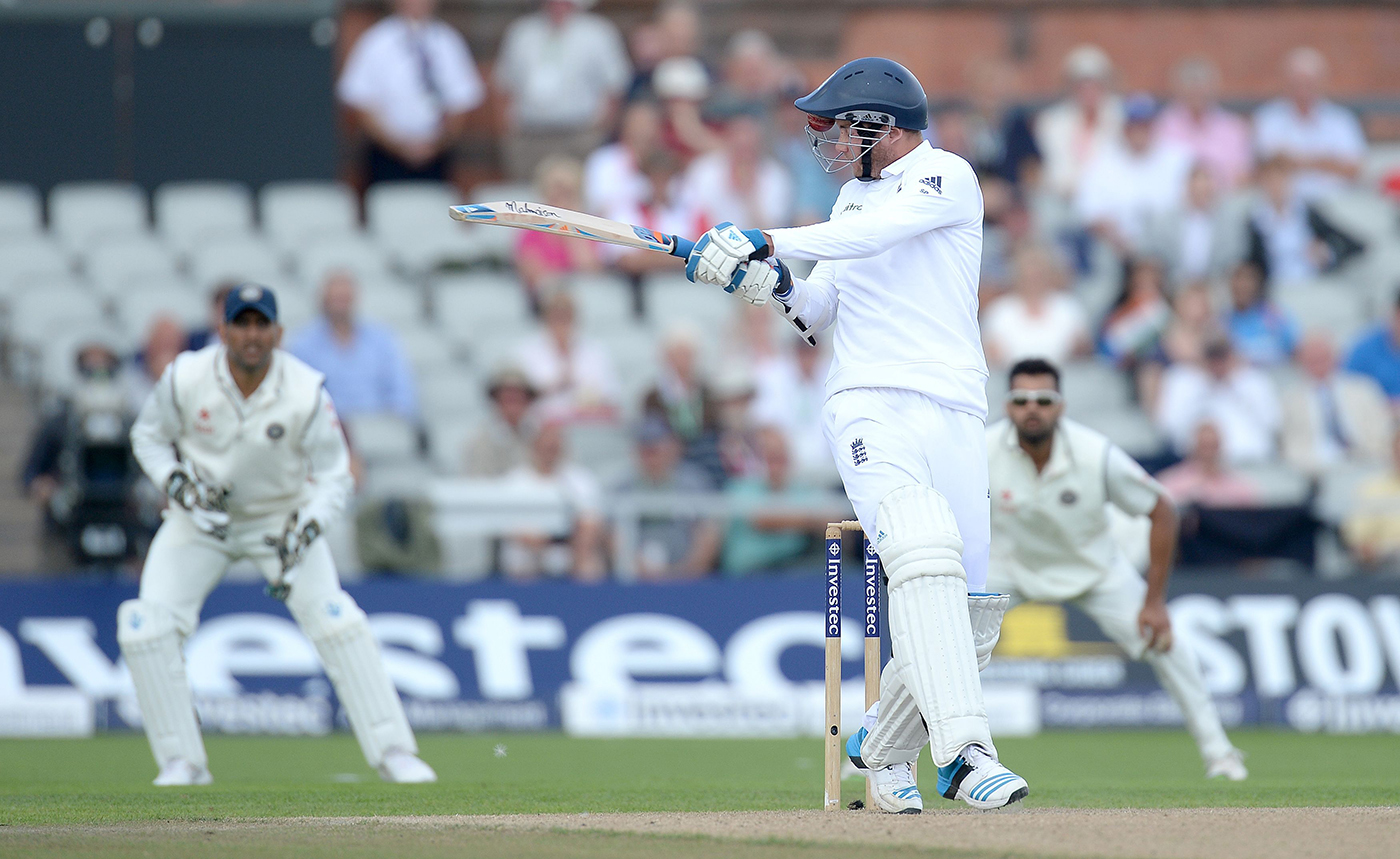
During the 2014 series, a bouncer from Aaron broke Stuart Broad's nose. After the day's play, the bowler (second from right) went to check on the batter's condition: "On the field, I was doing a job, but off the field, I was really concerned about how he was"
Martin Rickett / © PA Photos/Getty Images
I'm a little surprised to hear that, because by then there was a pretty decent establishment set-up for an India fast bowler. One would think that you would have had a lot of help to work on your action.
I had to fix it myself. I pretty much went to every single coach in the world and in India. But nobody could give me an answer.
And it's fine. Sometimes you just have to find your own answers. And I feel my journey, and especially trying to fix myself and come back, has really contributed to me understanding fast bowling to a level which I never thought I would.
So you come back and get picked for the 2014 Test tour of England.
I was very happy. I landed in England. The first three Tests, I didn't play. I was getting a bit edgy. I was like, when are they going to play me? Finally, I got a game [in the fourth Test in Manchester]. It was a really great three wickets I got in that first innings at Old Trafford: Moeen Ali, Gary Ballance and Alastair Cook. And I felt really good.
Okay, let's talk about the part where you broke Stuart Broad's nose. Do you remember if you felt any empathy at that time for the batter?
No, I didn't really care on the field, to be very honest, because that was just part of the job - scaring a batsman and trying to get him out after that. I did feel bad that he got hit and there was so much blood on the pitch.
The first thing I did when I went back was to go straight down to the English dressing room. Stuart Broad was laying down with an ice pack on his face. I asked him if he's okay and I apologised. I was like, "Man, you know what, I didn't mean to do that." He said, "Yeah, I completely understand." A couple of my team-mates were like: Why did you check on him? Why did you say sorry to him? I was like, guys, he's just another human and just one of us playing the game. Yes, on the field, I was doing a job, but off the field, I was really concerned about how he was.
Do you think that Test or that moment contributed to your county call-up later that season?
After that Test, we played at The Oval and then I came back home. I was obsessed with my body at that point, because I was told that you can't bowl more than these [many] overs. And I was bowling a lot in England in the nets at practice. And in the final two games, we had to bowl a lot. So I wanted to rest and make sure that I played for India. Then Ravi Shastri called me up one day and he was like, "Varun, I want you to play for Durham." In my head I was like: I was just thinking of doing some rehab, getting my back in proper shape. But then I went and played for Durham. That was a great experience. Just playing for an English county team. Young Ben Stokes was my team-mate there.
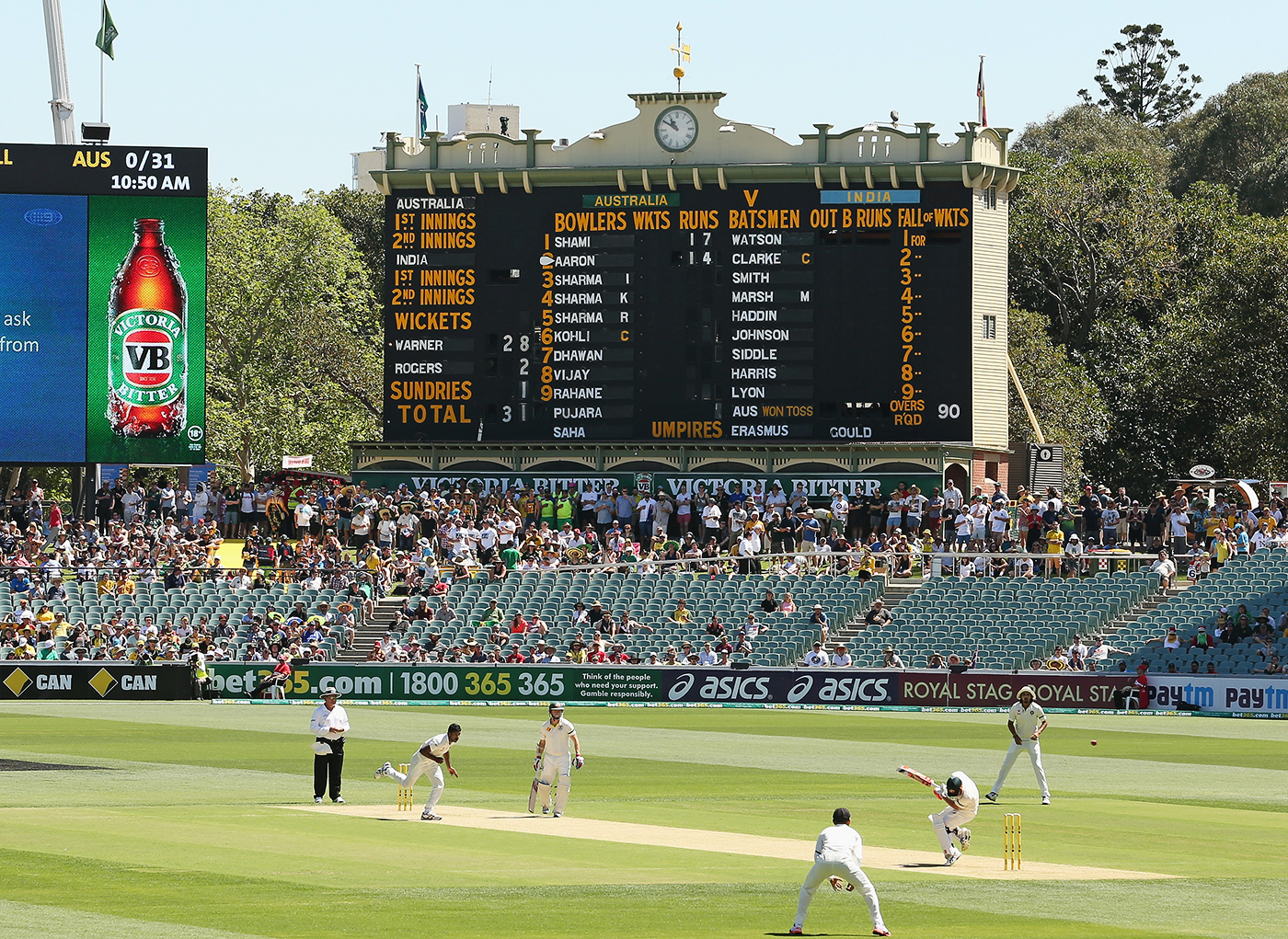
David Warner ducks a ball from Aaron: the 2014-15 Australia-India series was played while the cricket world grieved for Phil Hughes, who had died after being struck on the neck by a bouncer
Scott Barbour / © Getty Images
In my first game [against Northamptonshire], Chris Rushworth took 15 wickets.
He wasn't bowling well from his end. Paul Collingwood was the captain. He was like: "Varun, if you don't mind, Stokes only bowls from this end. Do you mind changing ends? Because I want to change Rushy after the next over." I said, sure, no worries. In the middle of the change, he [Rushworth] got one wicket. And Collingwood was like, you know what, let's just give him another one.
He got another wicket. And after that, Stokesy took one. Rushworth took eight [more]. We came back [for the follow-on] and Rushworth took another [six]. I was like, "Is this how cricket is played in England?" And then, next game, we play in Edgbaston, flattest track in England, and it's a long game.
Do you remember M Vijay dropping Alastair Cook off your bowling in the Oval Test?
We still talk about this. I was in the middle of a really good spell. And funnily, every time I played against Cook, I got him out. I was bowling around the wicket. He went for a drive. It went straight to Monk [Vijay] and Monk drops it. And he's a good friend of mine, so I can't even get angry. I was like, "Bro, can you just catch the next one?" He's like, "Yeah, I will." [A few overs later] I go over the wicket. Cook plays a drive. It goes to Monk and he catches it.
Later that year, India toured Australia. You got to bowl to your former team-mate David Warner. Do you remember dismissing him off a no-ball in Adelaide?
Oh yeah. This just started off a massive storm amongst both teams. Warner came back [having walked off before it was declared a no-ball] and he was mouthing everybody off on the way. Shikhar [Dhawan] and Rohit [Sharma] got into a fight [with Warner]. I was livid with myself, because if he was actually out, we could have won that Test. That Test was lost by not the biggest of margins. I didn't even want to engage with him because I was just like, "How could I have bowled that no-ball?"
Your celebration at dismissing him, before the no-ball was called, was quite emotional. Was that just in the moment or was that specifically for Warner?
It was in the moment because the Test was getting quite heated up. It was a young Indian team in Australia. We wanted to prove a point and David Warner was one of those characters who could run away with the game. I obviously wanted to get him out because I'm a fast bowler bowling against the opening batsman. You want that contest. So when I got him out, we were all really charged up. Virat Kohli's first Test as captain. So everybody was charged up.
In his India career, from 2011 and 2015, Aaron took 18 wickets in nine Tests and 11 in nine ODIs
Ajay Aggarwal / © Hindustan Times/Getty Images
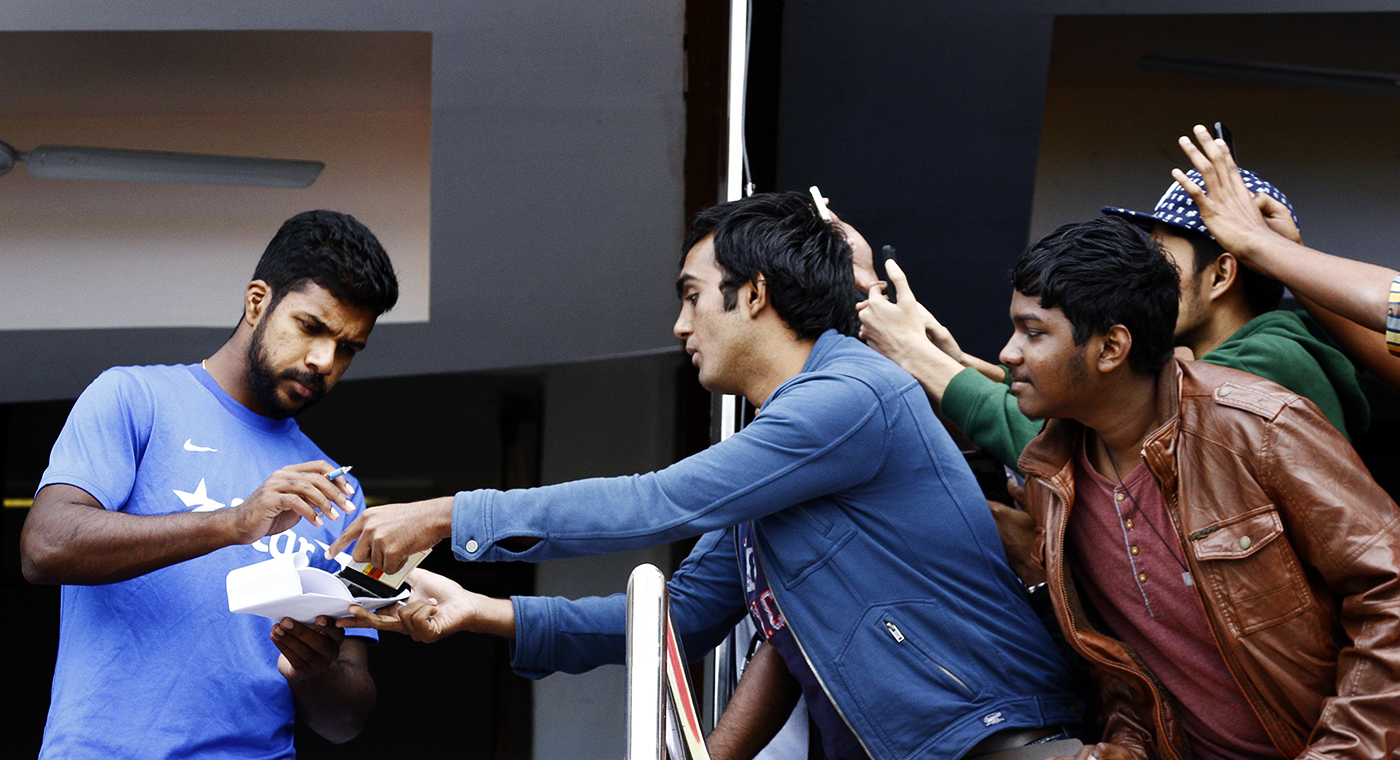
That series was really significant for cricket in a lot of ways. Phillip Hughes' passing [when he was hit by a bouncer on the neck while batting in a Sheffield Shield game before the Test series] was a seminal moment. Do you remember how that incident affected you as a fast bowler?
It's still very fresh in my head. The whole atmosphere around that first Test - the mood is very sombre. I remember Phil Hughes' number written on one part of the ground. That incident galvanised the Australian team to a large extent, because he was one of the liked members of the Australian team and it was a big loss for them. A big loss for world cricket. You just don't want anybody to die on the cricket field ever.
Did it make you second-guess your craft?
No.
When the series progressed to Melbourne, MS Dhoni decided he was done as India captain and with Test cricket. How would you describe your relationship with Dhoni, given you both come from the same state and he was your captain when you made your debut?
We had never met till I played for India, though we were from the same state, because he wasn't playing much Ranji Trophy cricket after he started playing for India. And I had just played two seasons of Ranji Trophy cricket myself. And when he debuted for India, I was playing U-15s, so we had never really crossed paths. The first time I met him was when I got selected for the Indian one-day team. We have a great relationship, but not an intimate one. I obviously have massive respect and admiration for what he's done.
Would you pick your dismissal of Hashim Amla in Bengaluru in 2015 as the best ball you've bowled in Test cricket?
I really enjoyed the Moeen Ali dismissal [at Old Trafford in 2014], but considering the conditions, I would say this ball [to Amla] was the best I bowled in Test cricket. And that was my last Test wicket as well.
Were you disappointed to not be selected for the 2015 ODI World Cup after the series you had in Australia?
So the last one-day series before the World Cup, before we left for Australia, was versus Sri Lanka. And I still vividly remember that game. We were playing Sri Lanka at the Barabati Stadium. I was averaging 147-148kph. I was bowling really fast and I was in really good shape. I think one of the lefties [Upul Tharanga] defended a ball. It took the shoulder of the bat, went for a one-bounce four over Suresh Raina's head. I was in great shape but all of a sudden, I popped my quad. So I had a grade-two tear and I missed the rest of that series. That was an important series to get picked for the World Cup. And I missed it because of injury. So just stuff like that.
Across nine seasons of the IPL, Aaron played for five IPL franchises, taking 44 wickets at a strike rate of 22.5
© BCCI

What was your experience in the IPL like?
I had a few really good years with Delhi Daredevils and Royal Challengers Bangalore. A good year with [Kings XI] Punjab as well. In my first year with Rajasthan Royals, I played about [five] games. I got a Man of the Match. But then after that, towards the end, it was just riddled with injury. I got dengue [twice] in the middle of two IPLs. I had to miss about seven-eight games. And my right quad just wasn't holding up. After that tear, which I just spoke about, my right quad would just pop in the middle of IPLs. And I just could not fix it.
You never took your injuries personally or emotionally?
A lot of people have asked me this, especially my family, because I've never really expressed too much. But to be really honest, it was just part of the mission. That's how it played out in my head: that you're doing this, stuff's going to happen to you, just move on with it. I don't think I've properly processed it even now.
You had interactions with a number of different coaches through your career. Did it make you think that you could also get into coaching?
I think what I learnt from my own experiences was massive. Yes, being coached by Dennis Lillee, Allan Donald, Bharat Arun, Steffan Jones, Eric Simons - very different styles of coaches, which you can pick up a lot from. But I think what you experience really shapes you, because a lot of the legends of fast bowling, who have just done it naturally and never really had a tumultuous journey in their careers, they just feel that it's really easy. They don't really understand somebody who goes through injury.
For somebody like me, it was, at some point, really torturous. I had so much information in my head and I had to break it all down and do something really simple. I would wish that I was a lot stupider and just did what I had to do without knowing too much about the craft. But I had to learn about it. I had to dig really deep into the knowledge of sport and fast bowling to even have a career past 25.
After the end of his playing career, Aaron has tried his hand at television commentary and coaching. He will be part of the Sunrisers Hyderabad coaching staff for the 2026 IPL
Saikat Das / © BCCI
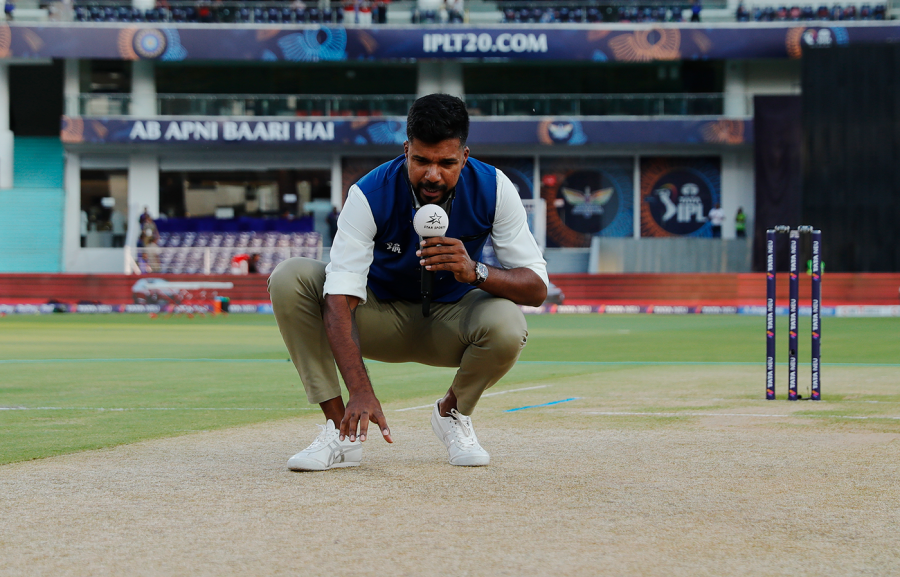
You're now going to be an IPL coach for Sunrisers Hyderabad. It's going to be your first coaching assignment - with a franchise at least. How excited are you are and what kind of coach do you think you'll be?
I'm really excited, because it's a challenge. Coaching at the Uppal Stadium is going to be a challenge, because that's one of the highest-scoring grounds in the IPL. I think the average first-innings score is about 213. To make sure our bowlers are on top of their games, to make sure we have the strategy, have the correct bowlers, have our bowlers bowling in a certain way is going to be so much fun. It's going to be creative. Because if you're playing on a track suited to bowlers, the creativity is less. The bowlers will just do their job.
But I think what I'm trying to do is focus as a coach more on the off-season rather than in-season, because you can't really contribute too much in-season. All you have to do is make sure everybody is in a great frame of mind when they are playing games. You don't want to really tinker with anybody's technique or put any information in their head which is going to make them [over]think. You just want them to be in a zone. But where you can actually do the work is in the off-season.
You've done commentary. You're going to be doing some coaching now. What are you more passionate about?
I think it's always going to be both, purely because I think my inherent want to help another human being comes out with coaching. But then through broadcasting, I get to put out my views on the game.
When you look back at your career now, do you have any regrets?
No regrets at all. Honestly, in life, I don't have any regrets. I have gone to sleep every day of my life feeling that I've given my best. I know I've put out everything I had on the field every day I took the field.
Raunak Kapoor is deputy editor (video) and lead presenter for ESPNcricinfo. @RaunakRK
© ESPN Sports Media Ltd.