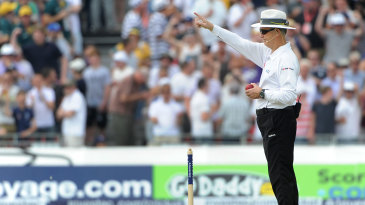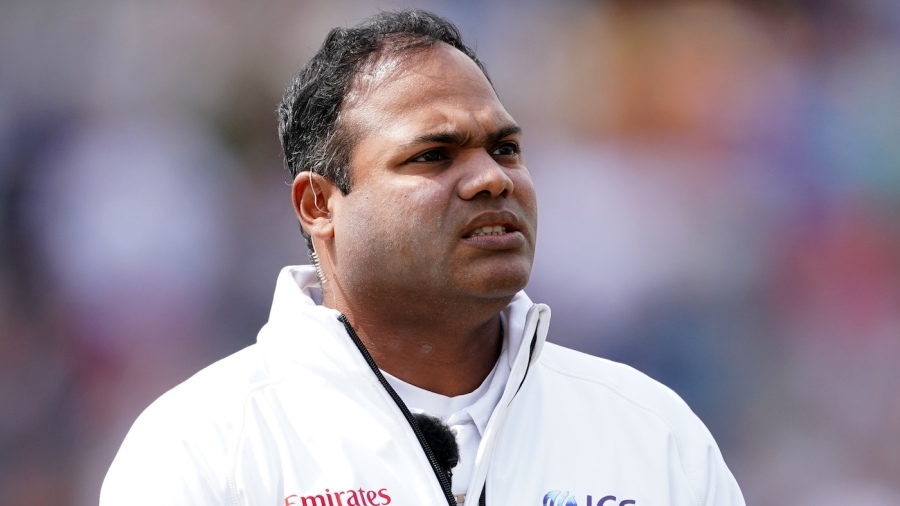





Half a decade into his career as an ICC Elite Panel umpire, Menon looks back at how far he has come and how he got here
Nitin Menon is the solitary Indian the ICC's 12-member Elite Panel. He made it to the panel in 2020 and has since grown into one of the best match officials around. Forty-two now, Menon once wanted to break Simon Taufel's record to become the youngest umpire on the Elite Panel. He talks about that, the hardest Test he umpired in, and why he now has the respect of the players and his peers.
The Trent Bridge Test you stood in in July was your 100th first-class match. Did you raise your cap to celebrate quietly?
Actually, I was not aware of that stat, but thanks for that. And no, we don't do that as umpires [raising the cap].
Do you keep track of how many matches you've stood in?
For Test matches, ODIs and T20s, I have done.
It must be a significant milestone for you?
Yes, it's a big number - 100 first-class matches means that I have been consistent and I have put in the yards. It doesn't come easily, though I'm in my 20th year in umpiring, domestic as well as international. So it's been a long time. It's a good milestone for me.
You have emerged as one of the best umpires around over the last decade. But before we talk about your highs, let's go back to your early days, where you were overeager to make an impression…
Yeah, initially when I started for BCCI [in domestic cricket], I was eager to make it to the International panel, eager to do IPL. So I was overdoing things, overthinking. In those days, when we started, we always felt that Simon Taufel was like… he started at a very early age and he became the youngest umpire to do an international game. I felt that I had to break his record, become an international or Test umpire before I reach 25-26.
[By thinking that] I was putting stress on myself. Yes, I was doing a few things I should not have done, and it pulled me back rather than took me forward. But those learnings from my initial years helped me later on in my career, when I got the right opportunities. And those learnings are still with me: Keep things simple. Umpiring is not rocket science, you just have to do the basics right and things will fall in place.
Your umpiring journey started in 2006. Before that, you played for Madhya Pradesh. Can you talk about how you came about to be an umpire?
At the junior level I was quite good [as a player] till the Under-19s. I was part of the Central Zone team too. But once I crossed U-23, I was not good enough to break into the [MP] first-class team. I overthought a lot of things, put pressure on myself, and my performances started to dip. And then I was dropped from the U-23 state team.
I thought I should continue, work hard, get back to the team, but luckily for me, the opportunity came from BCCI to appear in an umpiring exam. I was not feeling motivated to work hard as a cricketer, so I thought, why not make the switch? My father [Narendra Menon] umpired, so I decided to take up umpiring.
Menon in the 2017 IPL, also his first season as an ICC Elite Panel umpire
© BCCI

You were a batter?
Yeah, I was a middle-order batter.
Would you say you were moulded in the 1990s Test style of batting?
Hundred per cent. (chuckles) Then our idols were Rahul Dravid, VVS Laxman. There were no T20s at that time, so we used to just bat, bat, bat - that's it. Naman Ojha, Suresh Raina, Piyush Chawla, RP Singh, Umesh Yadav were my contemporaries - all of them in the same U-19 batch.
You said you were overeager in your decision-making in your early years. How did you correct that?
Back then, I felt I should be a bold decision-maker. So if the batter was playing on the front foot and getting hit on the pad and if it was hitting in line, I started giving it out, because I saw that was how it happened in international games. But I was getting the basics wrong because it doesn't matter where the batter plays actually, it is about whether the ball is going to hit the stumps - that is the most important thing.
When did you start settling down finally and become confident in your ability?
A couple of years after I started doing IPL, which I started in 2016. I had become an umpire straightaway from playing, so that was a challenge for me initially. I had no experience in local cricket compared to other guys who had done a lot of games as state-panel umpires before they became BCCI umpires. For me, it was just six-seven months of doing a few games in my state before I became a BCCI umpire. So in the early years I was still thinking a lot like a player.
I had to make tweaks in my mindset - no, I'm not a player, I have to start thinking like an umpire. At some point I also told myself, I am still 24 or 25, and those who are getting opportunities [to stand in IPL and international matches], they are almost 35 or 40 years old. So I still have a lot of time. I don't have to be an international umpire by the age of 26 or 27. That was the biggest thing that I told myself: there's no rush, because I have age on my side. That's when I settled down inside and just took it step by step.
You were 34 when you made your debut as an international umpire in the Kanpur T20 between India and England in 2017. Do you remember the first call you made?
It was a front foot no-ball. (laughs) There was no [technology for] no-ball then, so we had to call it on the field. And I remember the bowler as well, Chris Jordan.
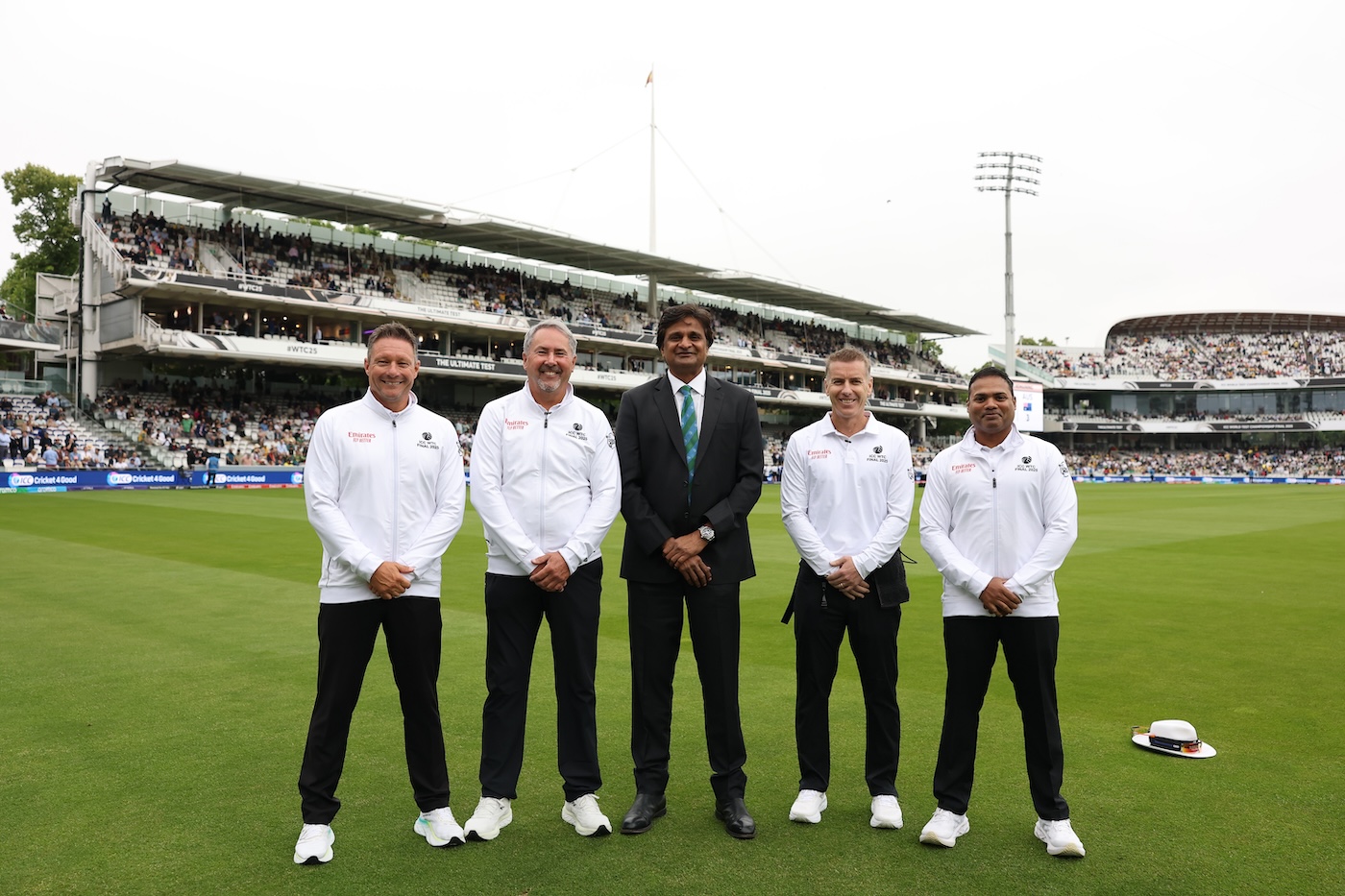
Menon (far right), the fourth umpire in the 2025 World Test Championship final, lines up with his colleagues before the start of play on day one
Alex Davidson / © ICC/Getty Images
Virat [Kohli], who was the non-striker, walked up to me and said quietly, "Are you sure?" So I thought to myself: What has happened? Have I missed something, or have I called a very tight one? I glanced at the English team dugout, where players and support staff had moved toward their video analyst to look at the replay, but they soon retreated to their seats. I realised then that I had made the correct call because otherwise they would have shown some disappointment from the dugout.
In three years you graduated to the ICC Elite Panel. Clearly you were doing things right. Was there any feedback you got from ICC coaches and umpiring colleagues that allowed you to move up the ranks quickly?
Luckily in that three-year period, I was getting most decisions right and DRS had come in for all bilateral series in India. But the biggest feedback, not only from match referees but also from my overseas umpiring colleagues, was that I was not scared of the big names on the field. [My colleagues] pointed out that if something was seen to be wrong, I had the courage to go up to that player and tell him to his face, "This is something you have to stop" or "This is something we are not happy about."
Does any incident come to mind that provides an example of that approach in the early phase of your international umpiring?
Once, an international captain was not happy with the ball. It was becoming wet, according to him. It was a day-night match and his team were fielding at night. He chucked the ball towards me. I caught the ball, I looked at it and I threw back at him straight away and said that the ball is fine, let's continue. And he did not like it. The next couple of hours, he was buzzing around in my ear, saying a lot of things, but we did not change the ball. All this was noticed by the match referee, Chris Broad, who could hear everything via the stump mic. I think me not taking a step back impressed him.
Your debut as an Elite Panel umpire was unusual, in that you stood in a home series in the age of neutral umpiring.
That was a strange period. I got selected in the Elite Panel in April 2020. I was very excited. I thought, now is my chance to do a lot of neutral games, travel around the world, and do Test matches in Australia and England especially. And then suddenly, unfortunately, Covid-19 came and there was complete lockdown around the world. There were series happening only in England at that time, in July-August, but English umpires did that series.
My first series was the India-England Test series in India in 2021. I stood in four Test matches, three ODIs and three T20s in that series. So basically almost every game, I was on the field. Luckily my performance was good, it was consistent, and it was seen by a lot of people. It amplified my image. We say that the first impression is [the most important], so I thought that first assignment was quite good for me.
You might think some players on both sides might have been a little sceptical, seeing an Indian umpire stand in home Tests. Did any of them compliment you at the end of the series?
Some players did compliment me, especially after the Test series, because the pitches were tough. And we always say as umpires that whenever the pitches are tough for batting, it is tough for umpiring as well. Overall my colleagues [and I] did a very good job. A lot of players like [R] Ashwin, Virat, came up and said it was one of the best series that they had seen on Indian soil. Joe Root, who was the England captain, spoke to Javagal Srinath, the match referee for the series.
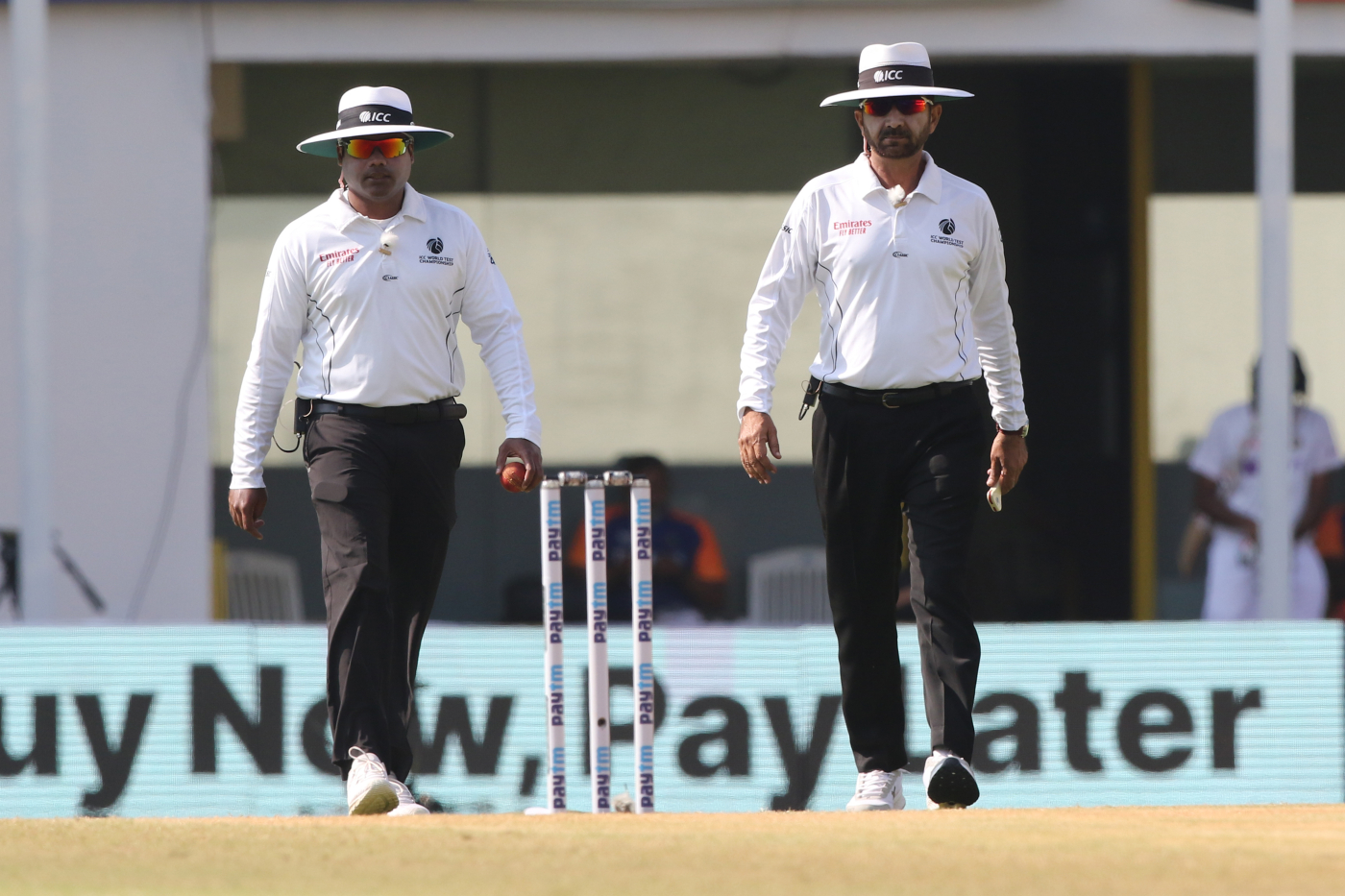
The first Test is the sweetest: Menon in his inaugural game as an Elite Panel umpire, in Chennai in 2021
© BCCI
You have said that you wanted to do the Ashes. Why?
Yes, it was my ambition to stand in the Ashes as soon as I got into the Elite Panel. Unfortunately I could not do it in 2021-22, but I got my chance in 2023, when it was held in England.
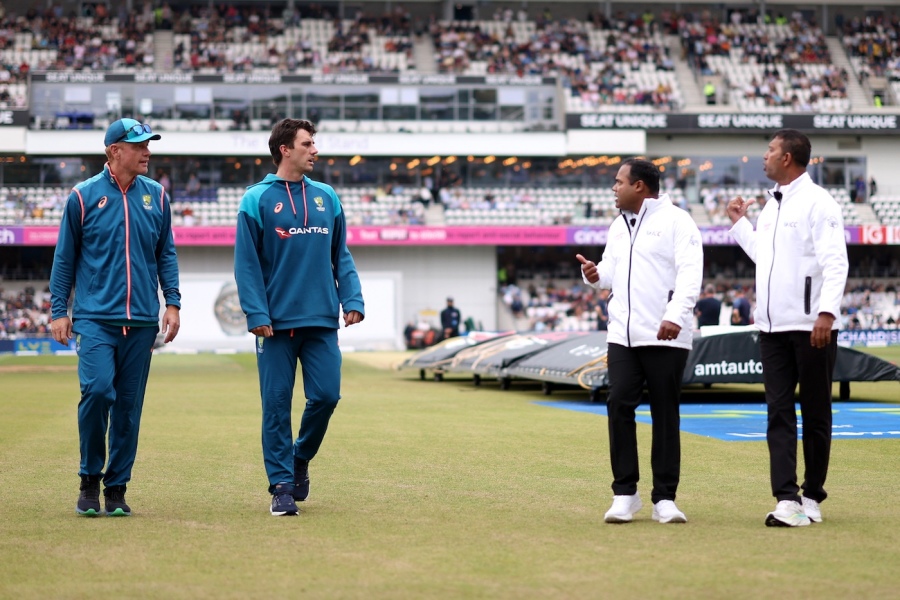
The Ashes in England was surreal, just the atmosphere inside the grounds, the competitiveness. I stood in the Test at Headingley and England were 2-0 down and that spell from Mark Wood, every ball was 90 miles per hour. Mitch Marsh got a brilliant hundred. Throughout the five days, the match was up and down. It was a great game of cricket. To stand in [my] very first Ashes Test, which went to the five days, it was really special. I can't describe how my feeling was on that day.
Personally, I feel that the best place to do a Test match is England - any series. I have stood in the England-West Indies series, England against South Africa, other than the Ashes in England. All the stadiums are jam-packed. People love their Test cricket. They are very appreciative, not only about the players but even when [the umpires] go out, people clap for us. At the end of the day they thank us, saying thank you for the day.
High-profile series such as the Ashes generally produce some calls that might become controversial. What was the challenge for you?
Actually [Headingley] was not a difficult pitch for umpiring. For me and my partner, Kumar Dharmasena, the main challenge was the bad light and rain. And as soon as the floodlights are turned on, the Dukes starts to do a bit more. So that was the most challenging part of that Test match. Overall it was played in very good spirit between both the teams. After that Test someone mentioned to us that it had never happened before that both on-field umpires were Asian in an Ashes Test and there were no errors from either. It was a big compliment for me.
Which is the most challenging of the three formats?
Hundred per cent, Test match. Every day of a Test can be a different scenario, different challenge: the first day with the moisture early on, the ball seams around in the first session. Second and third days, the pitch becomes good for batting, so it's a different challenge because now you have to focus - there will be long hours of play where nothing's happening and it might become a bit boring, but we still have to do our job. We have to stay focused every ball. And then the game explodes on the fourth and fifth day, when the cracks open, when the footmarks are very dusty and the spinners are trying to use that to their advantage. So for me the best format is Test cricket, and it is a unique challenge, which I don't think any other format of the game can come close to.
What kind of conditions and pitches are the most challenging?
Every country has different challenges. In the subcontinent when pitches start to turn, you have to focus hard on bat-pad catches because sometimes there is a lot of surrounding noise from the crowd.
Menon on Headingley 2023: "To stand in [my] very first Ashes Test, which went to five days, it was really special. I can't describe how my feeling was on that day"
© AFP/Getty Images
In Australia, where the bounce is quite high, we are more focused on the pull shots and whether the batter might have gloved it down the leg side.
In England, when it becomes overcast, the ball nips around a lot. On the first day it will be bright and sunny and you might think it will be an easy match, but suddenly the clouds come in and the Dukes starts doing all sorts of things. At that pace, around 140-145kph, when the ball nips around, it becomes a very difficult challenge. Also, the crowd makes a noise in the third session, making it difficult to hear things on the field.
In South Africa the pitches have moisture, good bounce, good pace. And when they get those indentations on the pitch and it becomes hard, there can be variable bounce, there can be a lot of seam movement. So that's a unique challenge, that those indentations make it very difficult to assess the bounce of the pitch: the ball might kick up or stay low from the same spot.
If you were to pick one, which of those has been the most challenging so far?
I will say the subcontinent.
And the most difficult Test you have officiated in so far?
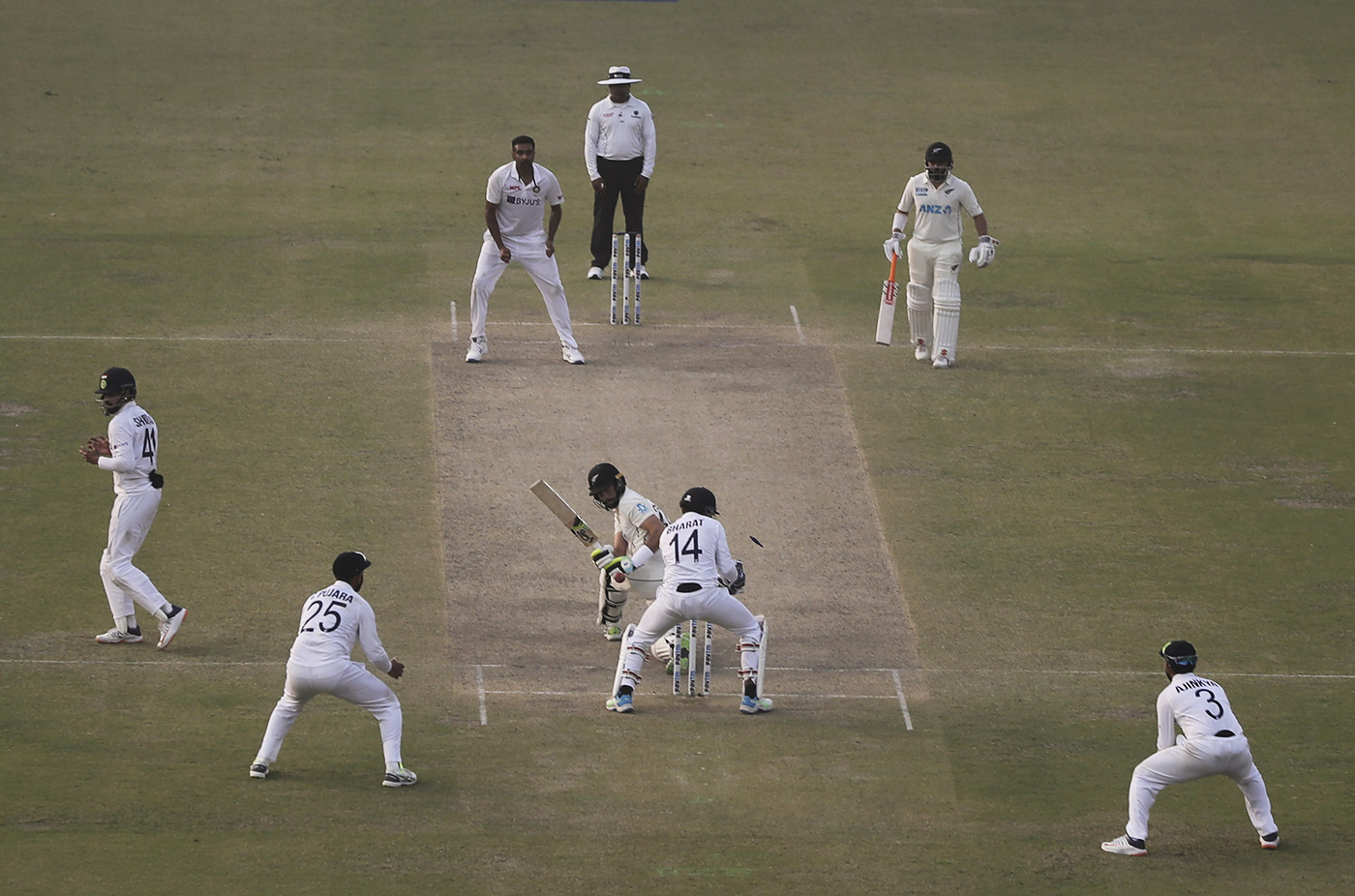
The India and New Zealand Test match in Kanpur during Covid-19. That was the second year of the pandemic. It was almost two years living and working out of a bio-bubble.
What about bad light?
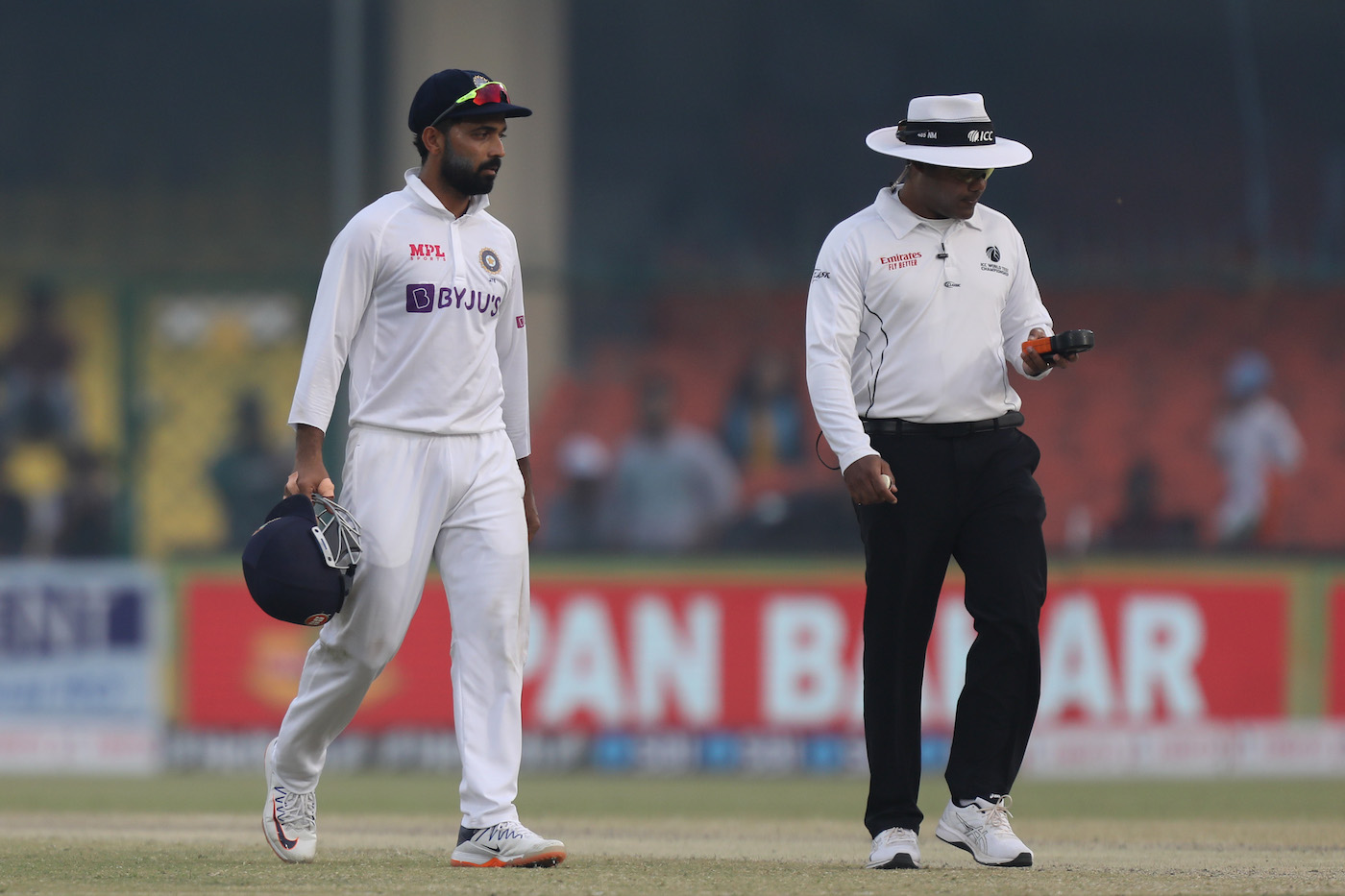
I will always say that as an umpire, our priority is the safety of players. I don't get what people have to say regarding spectators. We know how many times the players have come to us and told us that they are really finding it difficult to see the ball. It's not just about the bowler and the batter, it's also about fielders who are standing square of the pitch. If the background is not good, they can get smashed in the face with the ball. Or people standing at gully, when the batter plays a very hard cut shot.
We don't want a situation on a field where, because we could not stop the match, somebody has got badly injured. Player safety is paramount for us.
Menon says the 2021 Kanpur Test was the hardest he has stood in
Altaf Qadri / © Associated Press
To be classified as a good umpire you also need to be good at TV umpiring, which is not easy. Do you agree?
I agree that not everybody can be a good TV umpire. To be a good TV umpire, the first requirement is, your communication skills play a very big role because everyone can hear what you are saying when you are looking at a replay and making the decision.
I think sometimes that those who are not good in English as their first language, they become conscious and then their focus is more about what they are speaking rather than what they are looking at and making the decision on. As a third umpire your focus should only be to get the decision right, following the right process, right protocols.
For me, you are the Usain Bolt of TV umpires, quickly reviewing and making decisions.
(Smiles) I don't make quick decisions every time. When it needs further investigation, I do go and look for further replays. It's very simple: if I am satisfied as a third umpire with the evidence that I have got in the very first replay, there's no point to go and look for trouble by watching other angles. In my mind I know what's happening because that's the experience that we bring from on-field to third umpiring as well - that umpiring instinct.
We know from the first replay what it is showing us. If in the very first replay you get the money shot, you get the decision that you are looking for, what's the need for other angles? Just make a call on that.
It is similar to on-field umpiring, where your gut feeling says that it's out or not out and you go with that. The moment you start thinking, oh, the appeal was very strong, the batter's looking guilty, and then you try to go away from your gut instincts, you might go wrong. So similarly, those characteristics, we can bring it to third umpiring as well: in the very first replay, your gut instinct says, oh, this is what it is. And you stick with that, and obviously the replays and the footage are there to support you.
Which is the most challenging type of decision to review as a TV umpire?
For me, catches taken very close to the ground. Because the front-on camera angle gives a different perspective as compared to the side-on angle. That is because grounds all over the world have a slight slope. So if you see the ball from front-on, you might feel that the ball has bounced, but it might have bounced on the fingertips before going onto the palm of the fielder. Because of that gradient, the camera angle is making it seem like the ball has bounced on the ground and then gone into the palm of the fielder. We try to see all the different angles and then make a call.
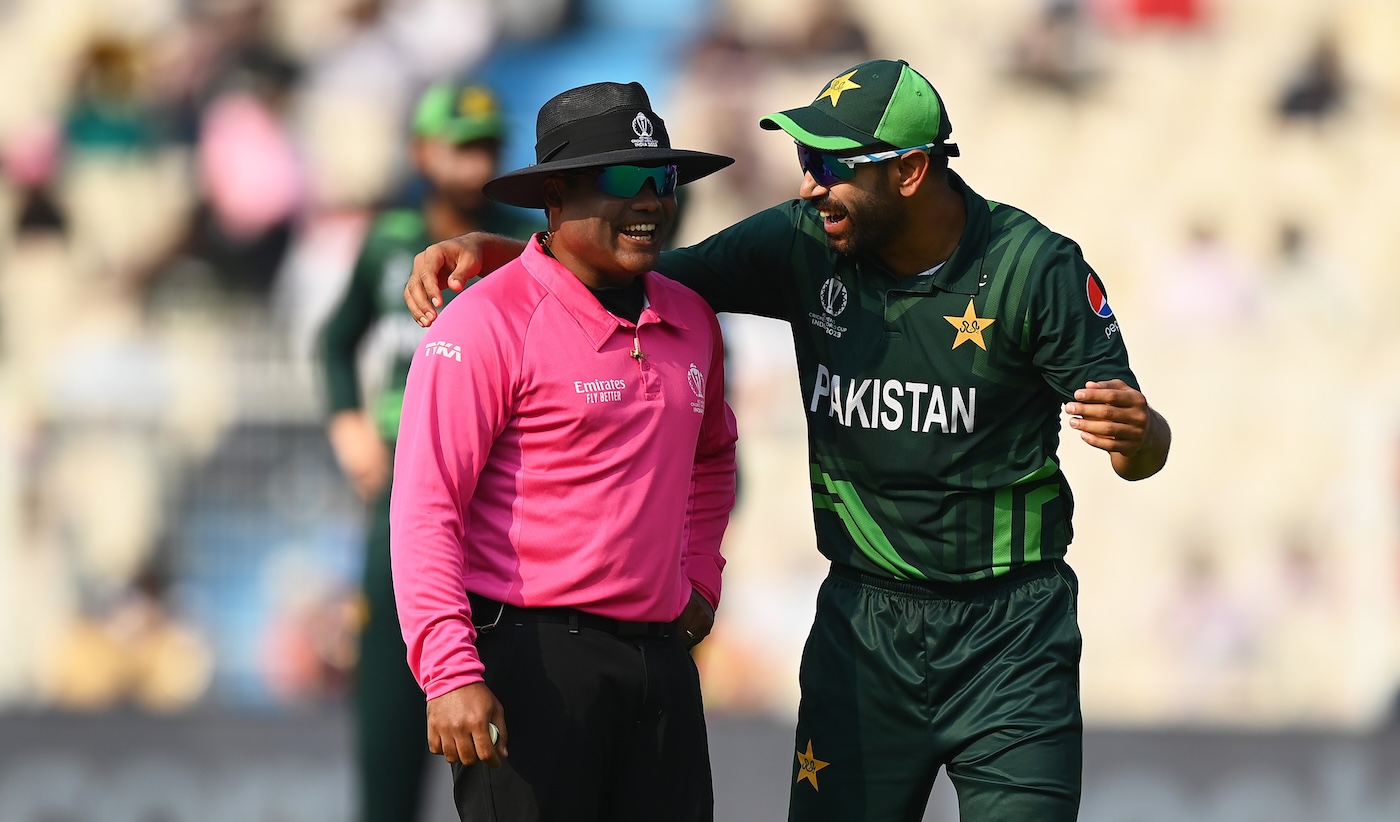
Me talk pretty one day: being able to communicate with players, relate to them and manage them is key for a good umpire
Alex Davidson / © ICC/Getty Images
Communication and relationship-building with players is important for an umpire. Do you think that relationship can get stronger if the players and coaches, and even broadcasters, educate themselves more about the laws and playing conditions?
Hundred per cent. Before commenting on air, broadcasters should first get it confirmed that they are on the right track. Do the Laws or the playing conditions support what they are saying? We don't expect the players to be very thorough with all the Laws and playing conditions, but yes, a lot of them are very good.
Sometimes what happens is that because of the pressure on the field of play, because of the match situation, though they know that it's not right under the spirit of the game, they still try to challenge the umpires. So I do feel that sometimes the coaches and the captains, they should be aware of at least the major Laws and playing conditions, before they actually go and challenge [the umpire] or they go and speak to the referee or the umpires.
During the 2023 Ashes in England, Sky Cricket had Marais Erasmus talk about why the catch Mitchell Starc took off Ben Duckett in the Lord's Test was ruled not out. In the ODI World Cup that year, after Angelo Mathews became the first player to be timed out, Ian Bishop spoke on air to Adrian Holdstock, who explained the ruling. Don't you think this kind of thing should become more common, where match officials can quickly offer a comment to clarify a decision and douse speculation and controversy?
Generally what happens is, if there is doubt among the commentators about certain playing conditions or rules, they get in touch with the third umpire. There is a communication system between the third umpire and the production team. So they get it clarified by the third umpire and then they try to go on air and tell the people that this is what the Law says.
I remember in the 2024 Test series between England and West Indies, one of the batters' bat broke and a part of it fell very close to the stumps. The commentators were not sure whether if the broken bat hit the stumps it would be declared as hit-wicket or not. I was third umpire in the Test match. Mike Atherton, who was one of the commentators, pinged me on the talk-back during the tea break and asked me what the exact rule was and where he could refer to it in the Laws. That was a nice conversation to have with him. And then he went on air in the third session and clarified that if any part of the person [hits the wicket], or any equipment which is detached, [like if] a bat is broken and a piece of the bat falls on the wicket and breaks the wicket, then the batter is out hit-wicket.
So this is how they are doing it nowadays - if they don't want the umpires to come and speak on air, they do get it clarified with them during the game.
Do you think the Indian umpiring system and pathways are modern and have adapted with the times?
My personal opinion is, umpires who have retired, let's say six, seven, ten years back, they should not be part of the current system. Because, for me, somebody who has umpired when there were no cameras, when there was no DRS, they don't understand the psyche of an umpire today, who is officiating with cameras, with technologies, how he looks into a game, how he prepares for a game. The professionalism itself has changed a lot. I will say the umpires coming up now are so professional compared to what we had ten, 15 years back. So I personally feel that somebody who has quit umpiring or has gone out of the system for the last five or ten years, they should not be part of the current system unless they have seen that level of elite umpiring or have been part of a group of elite match officials. Then that's fine because you still have that knowledge and you still have something to add.
Lead, kindly light meter: "We don't want a situation where, because we could not stop the match, somebody has got badly injured," Menon says
© BCCI
I can give my own example: compared to the umpiring I was doing in 2020, there's a big, big difference now in 2026 - in the way umpires are approaching the game or how they are preparing for the game. Smart replays have come in, so many things have changed, the DRS processes, protocols, playing conditions have changed. So I personally feel that if you want to look at the complete package of how an umpire is today, then somebody who has not seen this era of umpiring should not be making decisions on them.
Among the several areas where the IPL has set a good example is the use of technology to adjudicate accurately on over-the-waist no-balls, and even wides. Not all match officials are very keen on it, though. Marais Erasmus, who retired last year, writes in his book that he doesn't like that we are now checking beamers and wides using technology in the IPL. "Where do you see the umpire skill if you do that?" he says. What is your view?
I'm a big fan of technology. What people don't understand is that technology has not replaced on-field decision-making. It has only been introduced to support it. Technology is not there to give the first decision. The first decision is given by the on-field umpire, whether it is out or not out, wide or waist-high no-ball, anything. Only after that does technology come into the picture. So the skill of the on-field umpires of decision-making has not gone anywhere. It is just that if the teams feel that the decision is incorrect, then it is challenged and the technology comes in.
I will give you a scenario: last ball of a T20 final and let us say there is no DRS for wides and no-balls. Just one run is needed. A batter tries to flick a ball. The ball brushes the pad and because 35,000 people are screaming inside the ground, as an umpire, if I don't hear anything and I signal it wide, why should a team lose on a championship because of my error?
Technology is there to prove whether the umpire was right or wrong, and it has helped in the assessment of umpires as well. If there's no technology, if there are no cameras, then how do people know that the umpire was right or wrong? Technology tells us that, okay, this umpire has made a correct decision, or is a consistently good decision-maker, or not a very good decision-maker.
While there are skill-based tests to keep match official sharp, do you agree you need to like umpiring to be a good umpire?
Hundred per cent. Umpiring is a very tiring, very thankless, job. So if you don't enjoy umpiring, if you are just doing it for the sake of money or for any other reason, that's not the right job. I mean, standing six and a half hours in the sun and answering appeals, managing the players, it's not as easy as it might look on TV. It's quite a challenging job.
And there are a lot of skill sets which people don't see on the television, which an umpire needs to possess. People might see the decision-making skills of an on-field umpire, but there are a lot of other skills, like how you manage a match, how you manage a player where he's becoming grumpy or where he is trying to needle another player, how you communicate with so many players on the field, how you manage a bad-light situation. So it's not an easy job.
It might happen that initially you just got into the field just for the sake of money or just to try an alternative career - as I did. But if you then start enjoying and loving it, then again, that's very good. But after doing a few years of umpiring, if you feel that, no, this is not giving me that satisfaction, I don't think that you are in the right place.
Can you talk about two of the best matches you have stood in?
The 2019 IPL final was a career-defining match. That was the first time that an IPL final had an Indian umpire who was not part of the Elite Panel. In the 2018 IPL final I was the third umpire. So in 2019 for the first time IPL had an international umpire standing on field in the final. That was a big responsibility on my shoulders. Also, there were no reviews left for Chennai Super Kings on that last ball. So if by chance that decision was incorrect [Shardul Thakur was given out lbw], then I don't know what would have happened to my career (chuckles). So things fell into place. That was a very, very crucial game for me in my career.
I heard that a couple of ICC officials, who were involved with the selection of umpires for the Elite Panel, were watching that game in the stadium. They understood the amount of pressure there would have been on that last ball, and to give that decision. They were just saying that to handle that pressure [was commendable]. And CSK-MI is like Real Madrid against Barcelona, so to get that decision in that pressure game - that is what stuck with them.
This is the Shardul Thakur decision, right?
Yes. I don't remember what was going through my mind, what was happening, because I was just focusing on the pitch, as I always do with my normal umpiring. Really, I don't know how many people were screaming, which team were they supporting. I just saw [Lasith] Malinga delivering the ball, ball hitting the pad of Shardul, and then the appeal. That's it. That's what I remember, not what happened ten seconds before or five seconds before, nothing else. I was just in the zone.
Which is the other match?
I have already spoken about the Headingley Test. So I will pick the 2023 World Cup semi-final at Eden Garden between South Africa and Australia. That was my first ODI World Cup and to do the semi-final, which was a very close game, it was a very proud feeling for me. I feel that the ODI World Cups are like FIFA World Cups, which happen only once in four years. So they have that special environment, that special vibe, 50-over World Cups. And I felt that the competitiveness of a 50-over World Cup, compared to the four or five T20 World Cups that I have done, is definitely higher, and the 2023 ODI World Cup was one of the best.
What are some goals you have ahead of you?
I will not lie that I don't think about numbers. When I saw Rod [Tucker] doing his 100th Test match [the second Test of the 2026 England-New Zealand series], it motivated me to reach that level. You could see that from the way he was officiating in that Test, the way he was feeling, you could see that it was special. And even we around him, we were feeling so happy. Hundred Test matches is a long way away, and only four or five umpires have achieved that milestone. I would love to be in that position, to celebrate my 100th Test match. I'm not worried about ODIs or T20s. For me, the pinnacle of cricket is Test matches. So if I can achieve 100 Test matches, that will be a very nice to finish my career.
Let's hope Test cricket survives!
I'm sure it will survive. I 100% believe that without Test cricket no other cricket will survive. If somebody says that Test cricket is boring or Test cricket is not going to survive, I think they should go to a Test match in England or go and see a Test match in Australia and they will definitely fall in love with Test cricket. Especially in England. England is the best advertisement for Test cricket.
Nagraj Gollapudi is news editor at Cricinfo
© Jiostar India Pvt Ltd.